| ON THE COVER | 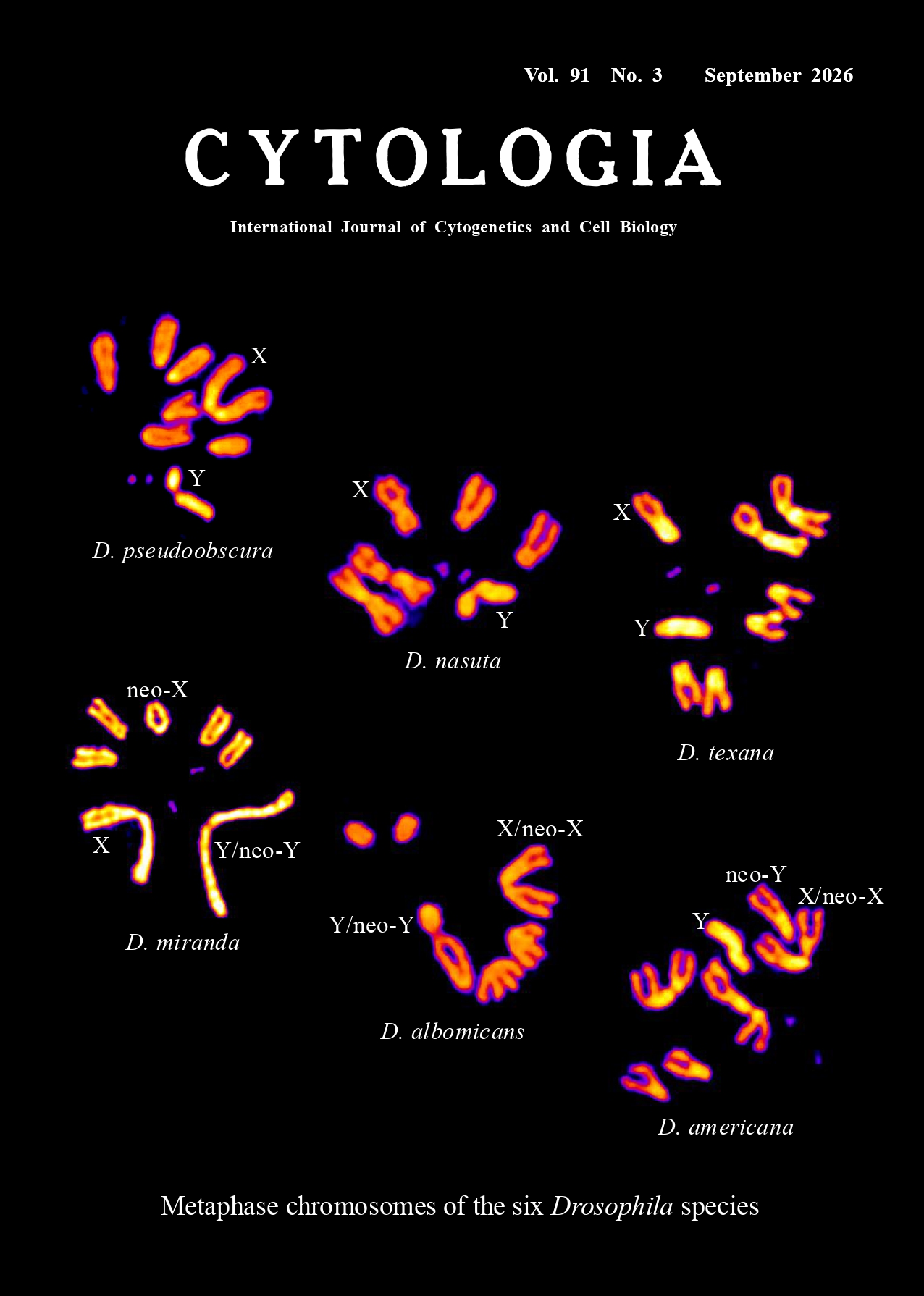 |
||
|---|---|---|---|
| Vol. 91 No.3 September 2026 | |||
| Technical Note | |||
|
|
|||
| Karyotype observations of Drosophila species for disentangling sex chromosome evolution Masafumi Nozawa1,2* 1 Department of Biological Sciences, Tokyo Metropolitan University, Hachioji, Tokyo 192–0397, Japan 2 Research Center for Genomics and Bioinformatics, Tokyo Metropolitan University, Hachioji, Tokyo 192–0397, Japan
The Y chromosome generally degenerates after originating from an autosome, mainly because recombination with the X chromosome becomes suppressed. In this context, dosage compensation (DC) is a key regulatory mechanism that alleviates copy-number imbalance of X-linked genes between the sexes and restores expression balance of genes on the X chromosome and autosomes in males. DC is found in diverse organisms, including Mus musculus, Caenorhabditis elegans, and Drosophila melanogaster, and its molecular mechanisms have extensively been studied (Ercan 2015). To understand how DC evolves, however, it is particularly useful to examine organisms with young sex chromosomes. In such organisms, the Y chromosome is expected to be at an early stage of degeneration, enabling to investigate the evolutionary interplay between Y-chromosome degeneration and the acquisition of DC on the X chromosome. Drosophila species provide an excellent system forthis purpose. In this genus, fusions between sex chromosomesand autosomes have occurred independently in several lineages. For example, D. miranda (bottom left of the cover art, 2n=9 for males) exhibits a distinct karyotype from its close relative, D. pseudoobscura (top left, 2n=10 for males), in which the ancestral karyotype has been maintained. This difference resulted from a fusion of an autosome with the Y chromosome, forming the neo-Y chromosome, while its unfused homologous autosome became the neo-X chromosome. In D. albomicans (bottom center, 2n=6 for males), after divergence from D. nasuta (top center, 2n=8 for males), one autosome fused with the X chromosome and its counterpart autosome fused with the Y chromosome, producing the neo- X and neo-Y chromosomes, respectively. In contrast, D. americana (bottom right, 2n=9 for males) experienced a fusion between an autosome and the X chromosome after divergence from D. texana (top right, 2n=10 for males), resulting in the neo-X chromosome, while the unfused homologous autosome became the neo-Y chromosome. These karyotypes can be identified by standard chromosome preparations. Neuroblasts are dissected from thirdinstar larvae in Drosophila Ringer’s solution and treated with a hypotonic solution (0.1% colchicine solution : 1% sodium citrate solution= 1 : 19) for 15 min. The cells are then fixed on a glass slide using fixative 1 (EtOH : acetic acid : water= 3 : 3 : 4), followed by fixative 2 (EtOH : acetic acid= 1 : 1). After air-drying, chromosomes are stained with 4% Giemsa solution for 30 min, rinsed with water, and observed at metaphase under a microscope. Combining karyotype observations with next-generation sequencing, we have shown that (1) gene-by-gene DC likely operates on neo-X chromosomes and (2) accelerated pseudogenization occurs not only on neo-Y but also on neo-X chromosomes. These results suggest that X-chromosome degeneration or feminization may occur, especially during the early stages of sex chromosome evolution (Nozawa et al. 2016, 2021). Utilizing the living stock collection maintained at Tokyo Metropolitan University, we have also uncovered unique sex chromosomes in other Drosophila species. These sex chromosomes would give us great insights to clarify the entire picture of the “sex chromosome cycle,” in which sex chromosomes and autosomes can be exchanged and turned over during evolution while stable sex determination is maintained (Hayashi et al. 2024).
Hayashi, S., Abe, T., Igawa, T., Katsura, Y., Kazama, Y., and Nozawa, M. 2024. Sex chromosome cycle as a mechanism of stable sex determination. J. Biochem. 176: 81–95. Nozawa, M., Onizuka, K., Fujimi, M., Ikeo, K., and Gojobori, T. 2016. Accelerated pseudogenization on the neo-X chromosome in Drosophila miranda. Nat. Commun. 7: 13659. Nozawa, M., Minakuchi, Y., Satomura, K., Kondo, S., Toyoda, A., and Tamura, K. 2021. Shared evolutionary trajectories of three independent neo-sex chromosomes in Drosophila. Genome Res. 31: 2069–2079. * Corresponding author, e-mail: manozawa@tmu.ac.jp DOI: 10.1508/cytologia.91.135 |
|||
 Back Archive list English Top Japanese Top Back Archive list English Top Japanese Top |
|||