| ON THE COVER | 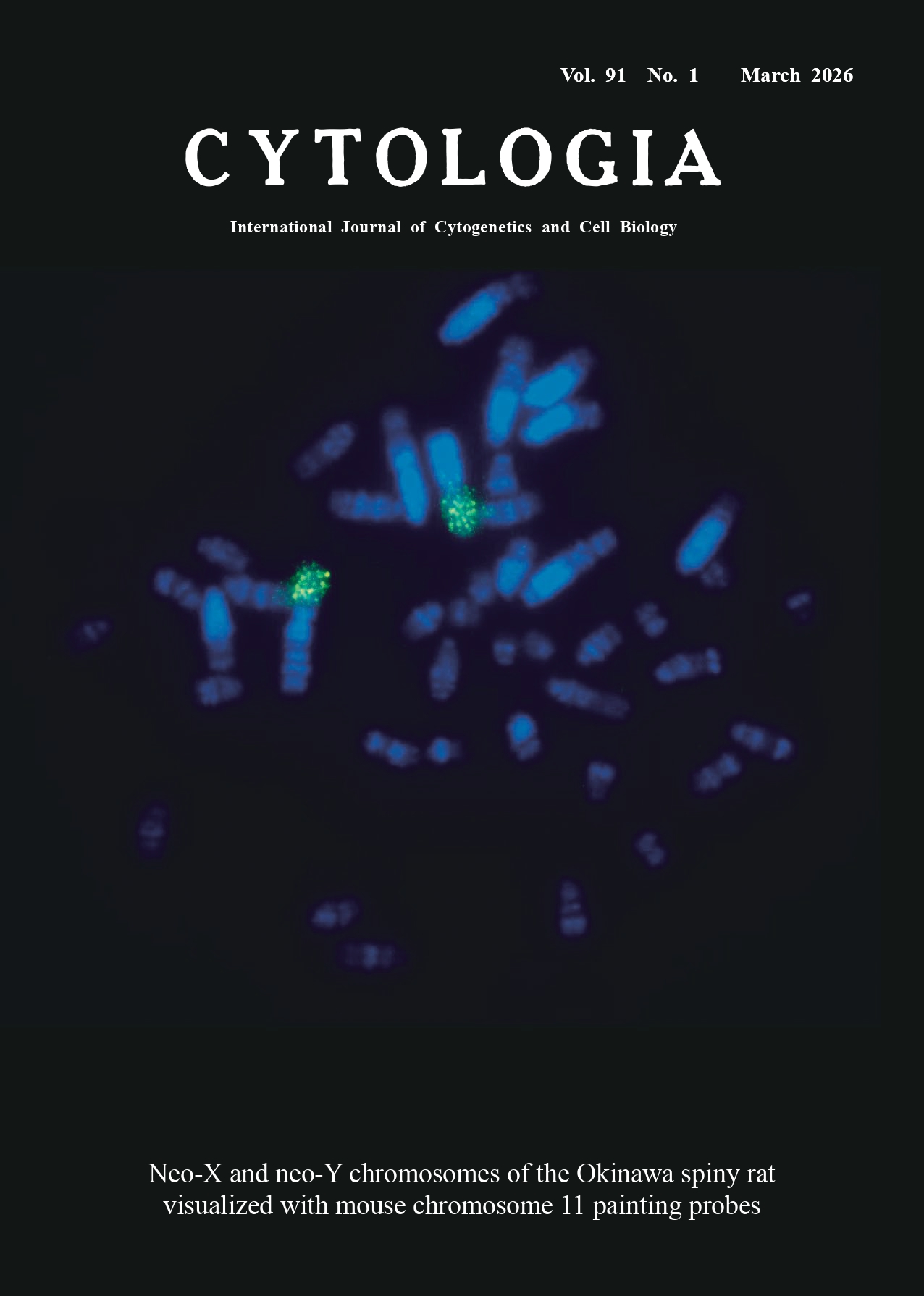 |
||
|---|---|---|---|
| Vol. 91 No.1 March 2026 | |||
| Technical Note | |||
|
|
|||
| ZOO-FISH mapping in the Neo-X and Neo-Y chromosomes of Okinawa spiny rat
(Tokudaia muenninki) Asato Kuroiwa* Division of Reproductive and Developmental Biology, Department of Biological Sciences, Faculty of Science, Hokkaido University, Kita 10 Nishi 8, Kita-ku, Sapporo, Hokkaido 060–0810, Japan
Mammalian X and Y chromosomes co-evolved from an ordinary pair of autosomes in the common ancestor, first appearing about 300 million years ago. During evolution, X–Y recombination was suppressed and the portions of the X and Y chromosomes that do not recombine during male meiosis increased. The reduced efficacy of purifying selection in non-recombining regions led to the accumulation of deleterious mutations in Y-linked genes. The subsequent inactivation and loss of Y-linked genes led to the genetic degeneration of the Y chromosome. The mammalian X chromosome is relatively large, making up about 5% of the haploid genome, and the size is highly conserved, with some exceptions. By contrast, the mammalian Y chromosome is extremely small and contains very few genes. The remaining Y chromosome genes acquired male-specific functions, including roles in sex determination (SRY) and spermatogenesis, and are consequently essential for maleness in mammals. It has been difficult to assemble the genome sequences of the Y chromosome owing to the excessive accumulation of repetitive sequences and transposable elements. The spiny rats, which belong to genus Tokudaia, Muridae, Rodentia, are interesting models of rapid and unique chromosomal evolution. The genus includes three species, each indigenous to only a single island in southernmost Japan. The Amami spiny rat (Tokudaia osimensis) and Tokunoshima spiny rat (Tokudaia tokunoshimensis), which live on Amami-Ohsima island and Tokunoshima island, respectively, have XO/XO sex chromosome systems (i.e., they lack a Y chromosome). Therefore, T. osimensis and T. tokunoshimensis have odd-numbered diploid chromosome numbers, 2n=25 and 2n=45, respectively. In addition, the genomes of these XO species lack the SRY gene. The remaining one, the Okinawa spiny rat (Tokudaia muenninki), which lives on Okinawa-jima island, has an XX/XY sex chromosome system and a diploid chromosome number of 2n=44. T. muenninki is the only species in the genus Tokudaia that has maintained the Y chromosome; as a consequence, it follows the general XY pattern of mammalian sex determination. However, the Y chromosome of T. muenninki has evolved in a unique manner, possibly because it was unstable in the common ancestor of the genus. In the ancestral lineage common to the two XO spiny rats, T. osimensis and T. tokunoshimensis, a few Y-linked genes escaped to the X chromosome, and the Y chromosome was subsequently lost. By contrast, in the ancestral population of T. muenninki, the X and Y chromosomes fused with a pair of autosomes and acquired Neo-X and Neo-Y. The cover figure shows an interspecific fluorescence in situ hybridization (ZOO-FISH) result, in which a FITC-labeled mouse chromosome-painting probe was hybridized to the chromosomes of the Okinawa spiny rat (Murata et al. 2012). Mouse chromosome 11-specific probe was hybridized to the short arms of both the X and Y chromosomes, and this result suggests that the short arms of the X and Y chromosomes are derived from autosomes. More recently, chromosome-level genome assemblies were generated for male individuals of all three Tokudaia species using long-read sequencing and Hi-C technology (Okuno et al. 2025). High-quality genome assemblies revealed that many Y-linked genes, including SRY, exist in multiple copies due to extensive duplications, and that some of these copies have also translocated to the X chromosome.
The Y chromosome of the Okinawa spiny rat, Tokudaia muenninki, was rescued through fusion with an autosome. Chromosome Res. 20: 111–125. Okuno, M., Matsuoka, K., Mochimaru, Y., Yamabe, T., Okano, M., Jogahara, T., Toyoda, A., Kuroiwa, A., and Itoh, T. 2025. Where did the Y chromosome in the spiny rat go, and how did it get there? Mol. Biol. Evol. 42: msaf102. * Corresponding author, e-mail: asatok@sci.hokudai.ac.jp DOI: 10.1508/cytologia.91.1 |
|||
 Back Archive list English Top Japanese Top Back Archive list English Top Japanese Top |
|||